History
Our origin story
Buildpacks were first conceived by Heroku in 2011. Since then, they have been adopted by Cloud Foundry and other PaaS such as Google App Engine, Gitlab, Knative, Deis, Dokku, and Drie.
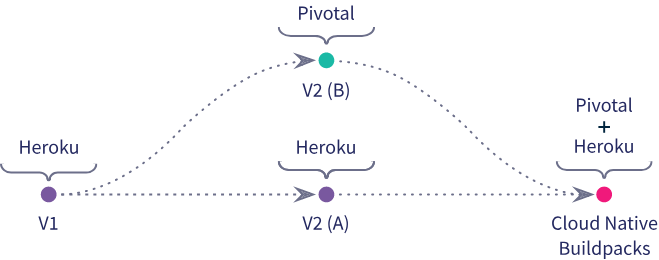
The Cloud Native Buildpacks project was initiated by Pivotal and Heroku in January 2018 and joined the Cloud Native Computing Foundation(opens in a new tab) in October 2018. The project aims to unify the buildpack ecosystems with a platform-to-buildpack contract(opens in a new tab) that is well-defined and that incorporates learnings from maintaining production-grade buildpacks for years at both Pivotal and Heroku.
Cloud Native Buildpacks embrace modern container standards, such as the OCI image format. They take advantage of the latest capabilities of these standards, such as cross-repository blob mounting and image layer “rebasing” on Docker API v2 registries.
Graduation
Cloud Native Buildpacks joined the CNCF as a Sandbox project in October 2018 and graduated on 11 August 2026, the foundation’s highest maturity tier, reserved for projects that have demonstrated production adoption, vendor-neutral governance, and sound security practices.
Graduation followed a third-party security audit by Quarkslab and the Open Source Technology Improvement Fund (OSTIF), an OpenSSF Best Practices badge, and adoption of the CNCF Code of Conduct. At the time of graduation, the project counted 535 contributors across 164 organizations, with adopters including Bloomberg, DigitalOcean, GitLab, Google, HashiCorp, Heroku by Salesforce, Spring, and VMware by Broadcom.
Read the CNCF’s graduation announcement(opens in a new tab) for the full detail.